
Salesforce just announced Headless 360.
At first glance, it may sound like another product launch with a new name.
It is more important than that.
Headless 360 signals a continued shift in how Salesforce will create value moving forward: less dependent on users working inside the traditional CRM interface, and more focused on powering AI, automation, connected systems, and custom digital experiences.
For businesses already using Salesforce, this matters now.
What We Cover
What Is Salesforce Headless 360?
In practical terms, Headless 360 points toward using Salesforce as the engine behind the scenes rather than only the place where work happens on screen.
That means Salesforce data, workflows, and logic can support:
- AI agents and assistants
- Customer portals
- Mobile apps
- Automated service experiences
- Internal business tools
- Connected partner systems
- Custom digital experiences
Instead of asking people to log into Salesforce for everything, businesses can bring Salesforce capabilities into the places where work already happens.

Why This Matters Right Now
Three major trends are colliding:
1. AI Needs Access to Real Business Systems
AI is only valuable when it can work with trusted data and take useful action.
That means reading account data, updating records, triggering workflows, summarizing opportunities, routing cases, and more.
2. Customers Expect Better Expeiences
Customers do not care what system powers an experience. They care whether it is fast, accurate, and easy.
3. Teams Want Less Friction
Employees are tired of switching between tools, duplicate entries, and clunky workflows.
Headless 360 aligns with all three.
What This Could Mean for Existing Salesforce Customers
If your business already uses Salesforce, this could unlock more value from investments you have already made.
Examples include:
- Smarter lead routing and follow-up
- AI-generated account summaries
- Faster service workflows
- Custom portals powered by Salesforce data
- Better integrations across departments
- Simpler tools for non-CRM users
For many companies, the next wave of ROI may come from extending Salesforce, not replacing it.
What Could Break in a Messy Salesforce Org
Here is the part many businesses overlook.
AI and automation do not fix bad foundations. They expose them.
If your Salesforce org has:
- Duplicate data
- Reporting distrust
- Old automation conflicts
- Weak permissions
- Poor user adoption
- Integration sprawl
…then new headless or AI initiatives can create bigger problems faster.
Speed on top of chaos is still chaos.
What Smart Companies Should Do Next
Before chasing every new feature, focus on readiness.
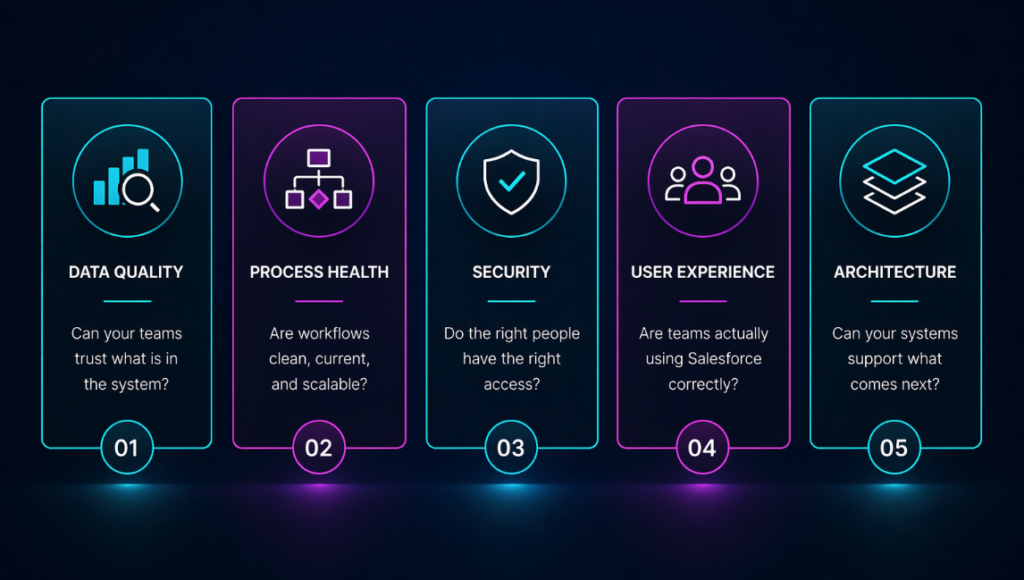
Smart companies evaluate five core areas before scaling AI inside Salesforce:
Data Quality
Can your teams trust what is in the system?
Process Health
Are workflows clean, current, and scalable?
Security
Do the right people have the right access?
User Experience
Are teams actually using Salesforce correctly?
Architecture
Can your systems support what comes next?
The companies that win with AI are usually the ones that prepared before everyone else did.
Our Take
Headless 360 is about turning Salesforce into a more flexible operating platform for growth.
That creates a real opportunity for companies willing to modernize with intention.
But it also means messy orgs may fall further behind.
Final Thought
Salesforce Headless 360 is a sign of where the market is going: connected systems, smarter automation, and AI working across the business.
The question you need to be asking yourself is…
Is your Salesforce environment ready for them?
If your Salesforce org feels cluttered, slow, overcomplicated, or difficult to trust, now is the right time for a cleanup and readiness review before the next wave hits.